Seating chart for 100 guests
A seating chart for 100 guests comes down to table math and clean groups: decide on ten tables or eleven, keep parties intact, and balance every table.
Updated
For 100 guests you need at least 10 round tables of ten, and 11 tables give you room for late replies. At tables of eight you need 13 (104 seats), and at tables of twelve you need 9 (108 seats).
| Seats per table | Minimum tables | Recommended |
|---|---|---|
| 8 | 13 (104 seats) | 14 (112 seats) |
| 10 | 10 (100 seats) | 11 (110 seats) |
| 12 | 9 (108 seats) | 9 (108 seats) |
A head table or sweetheart table is counted on its own, on top of these guest tables. When Tablecharm adds one, a head table starts with 8 seats and a sweetheart table with 2. Try another guest count in the tables calculator.
One hundred guests is a comfortable size to plan, with room to adjust. The goal is not just to fit everyone. It is to seat people beside company they will enjoy, keep families and plus-ones together, and make sure no table looks half empty. Tablecharm handles the arithmetic for you: paste your list, set your table size, and it fills the room while keeping your groups whole. The editor and solver are free to try.
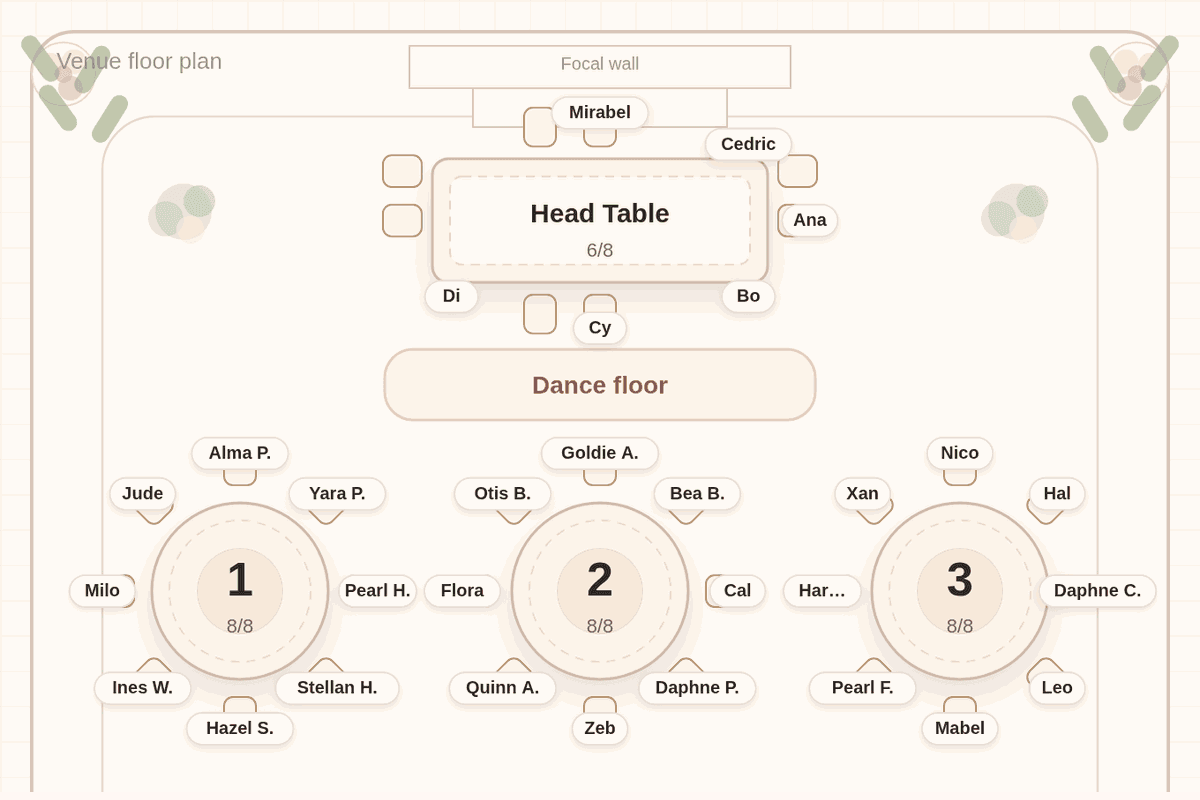
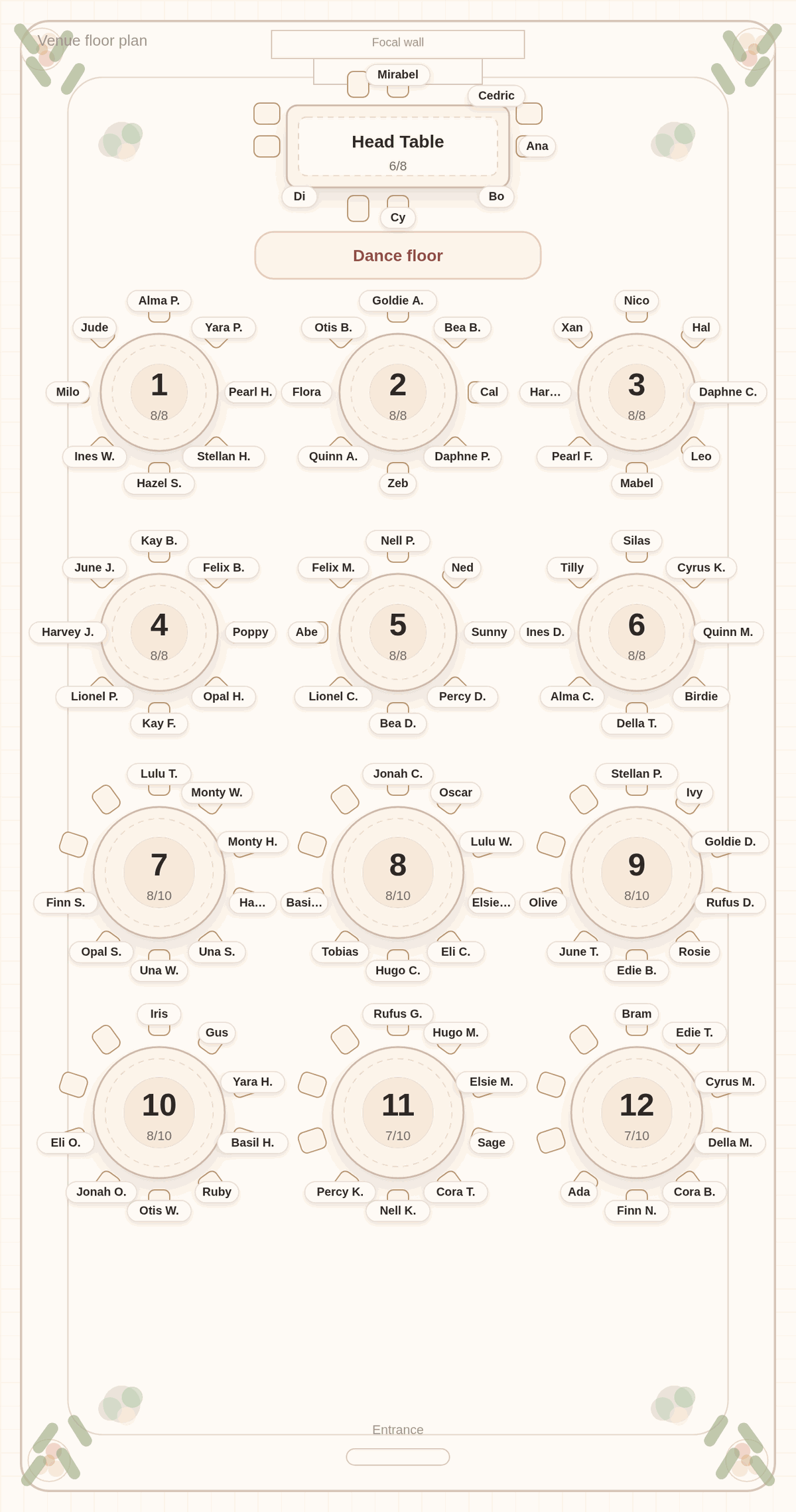
Ten tables of ten, or eleven
With 100 guests, ten tables of ten is the tidy default. It looks balanced and it is easy to picture. The trouble is that ten leaves no slack, so one late reply can force a reshuffle. Eleven tables give you breathing room: 110 seats for 100 guests, so most tables seat nine and ten seats stay open for changes, which almost always happen.
Either approach works. If your venue charges per table or space is tight, ten keeps things lean. If replies are still trickling in, plan for eleven and let a couple of tables run slightly light. In Tablecharm you can change table count and re-solve in seconds to compare both.
Keep groups together as blocks
The fastest way to make a hundred-person chart feel right is to keep natural groups intact. A family of six, a couple and their two friends, a work pod of five: seat each block together rather than splitting it to even out numbers. Guests notice when they are seated with strangers while their group sits elsewhere.
Mark these as keep-together in Tablecharm and the solver treats each block as a unit. It will slot a group of six into a table of ten and fill the remaining seats with compatible guests, so nobody who came together ends up marooned across the room.
Balance so no table looks sparse
An uneven room reads as an accident even when it is not. A table of four next to a table of ten looks lonely, and the guests at the small one feel it. Aim to keep every table within a seat or two of the others, so the room looks intentional from the door.
This is hard to eyeball with a hundred names. Tablecharm distributes guests to keep tables balanced while respecting your groups and rules, so you avoid the classic problem of one crowded table and one that sits nearly empty near the back.
Seat by the room, not the list
Once the tables are set, think about where they sit. Older relatives appreciate being away from the band and near an easy exit. Close family and the wedding party usually belong near the head or sweetheart table. Guests with young children like being close to the door.
You can express these as a near-the-head-table preference or by placing specific tables yourself. In Tablecharm the solver fills seats, but you stay in control of the floor plan, dragging tables where they make sense for your venue. When you print, the poster mirrors that layout so guests read the room the way you designed it.
Questions couples ask
How many tables do I need for 100 guests?
For round tables of ten, you need 10 tables at a minimum, and 11 give you room for a late reply or a group that must stay together. If your tables seat eight, you need at least 13: twelve tables of eight is only 96 seats, and 13 is 104. Plan on 13 or 14, and lean toward 14 while replies are still coming in. Tables of twelve need 9, which is 108 seats. A head table or sweetheart table is extra, on top of these.
Should every table have the same number of guests?
Close, but not exact. Keeping tables within one or two seats of each other looks intentional, while a table of four beside a table of ten looks off. It is fine to run a few tables slightly light, especially if you are holding seats for late replies.
Can I mix table sizes for 100 guests?
Yes. A common setup is mostly tens with one or two eights for smaller groups, plus a head or sweetheart table. Mixing sizes helps you keep families whole without leaving odd empty seats. Tablecharm lets you set a capacity per table and solves around all of them.
Should I use 60 inch or 72 inch round tables for 100 guests?
Use what your venue or rental company actually has. How many fit at a given round depends on its diameter, the chairs and the centerpieces, so ask the venue for its tables and the seat count it uses for each. Then plan from that number: at eight a table you need at least 13 tables, at ten you need 10, and at twelve you need 9. In Tablecharm you set the seats for each table, so a room with two sizes of round works too.
How long does it take to make a seating chart for 100 guests?
The solve itself took under two seconds in our 100-guest example. Preparing the list and checking the result take longer, and vary most with how organized the list already is. Having names, couples and families, and a few keep-together and keep-apart rules ready before you start makes the rest go faster.
How do I handle plus-ones and late RSVPs with 100 guests?
Build in slack from the start: eleven tables of ten, or 14 tables of eight, leaves open seats for a late yes. Add each plus-one next to the guest who is bringing them, even before you know the name, and keep the two together so they land at the same table. When a late reply arrives, lock the tables you are happy with, add the guest, and solve again so the open seats fill around your rules.
Does the head table count as one of the guest tables?
No. A head table or sweetheart table is counted on its own, on top of the guest tables. Size the guest tables for your list first, then add the head table or sweetheart table. When Tablecharm adds one to the room, a head table starts with 8 seats and a sweetheart table with 2.
Solve this in a few minutes
Paste your guest list, add your keep-apart rules, and let Tablecharm build the first draft. The editor and solver are free while you experiment.
Preview free. Unlock one wedding for $29 when you print.