Family situations
Where to seat stepparents at a wedding
Each parent sits with their partner, each household gets a place of honor near the front, and nobody is sent to the back to keep the peace.
Updated
Stepparents raise a seating question that has no single right answer, because it depends on how the adults in your family get along today. Some divorced parents share a table happily. Others should not share a room. Most sit somewhere in between: polite, but happier with a little distance.
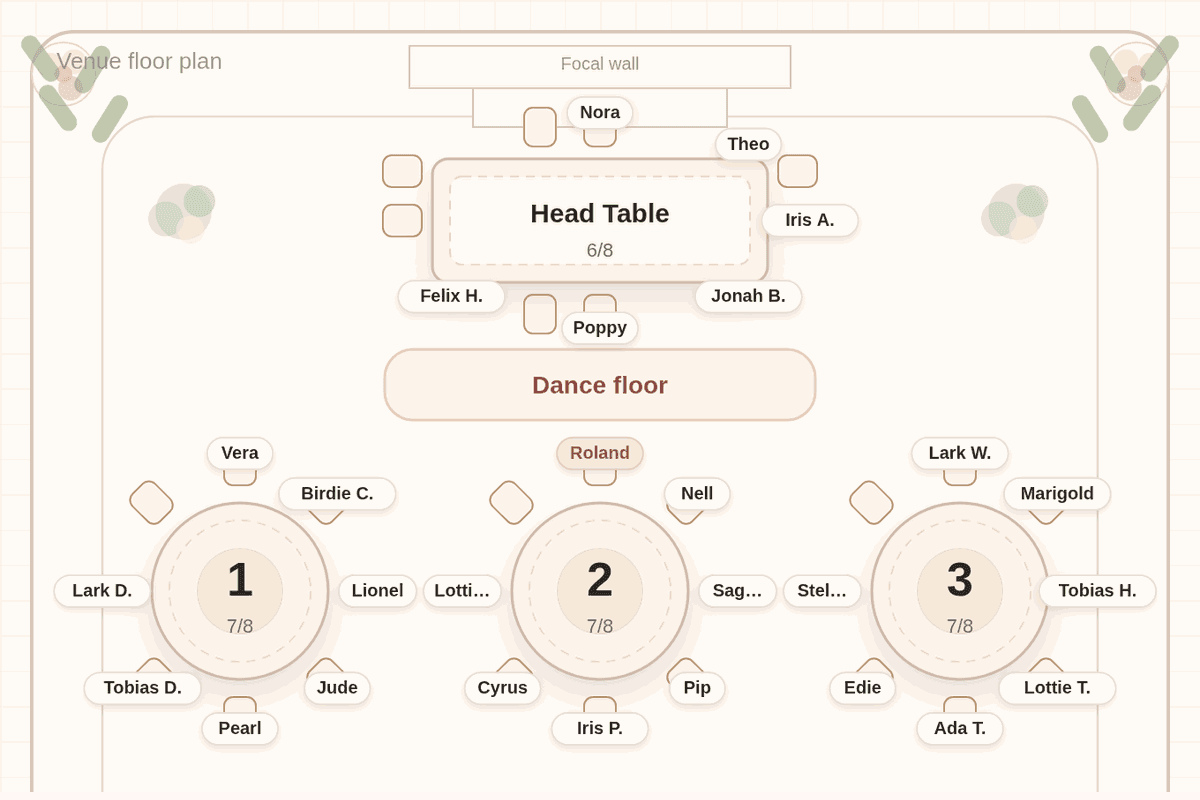
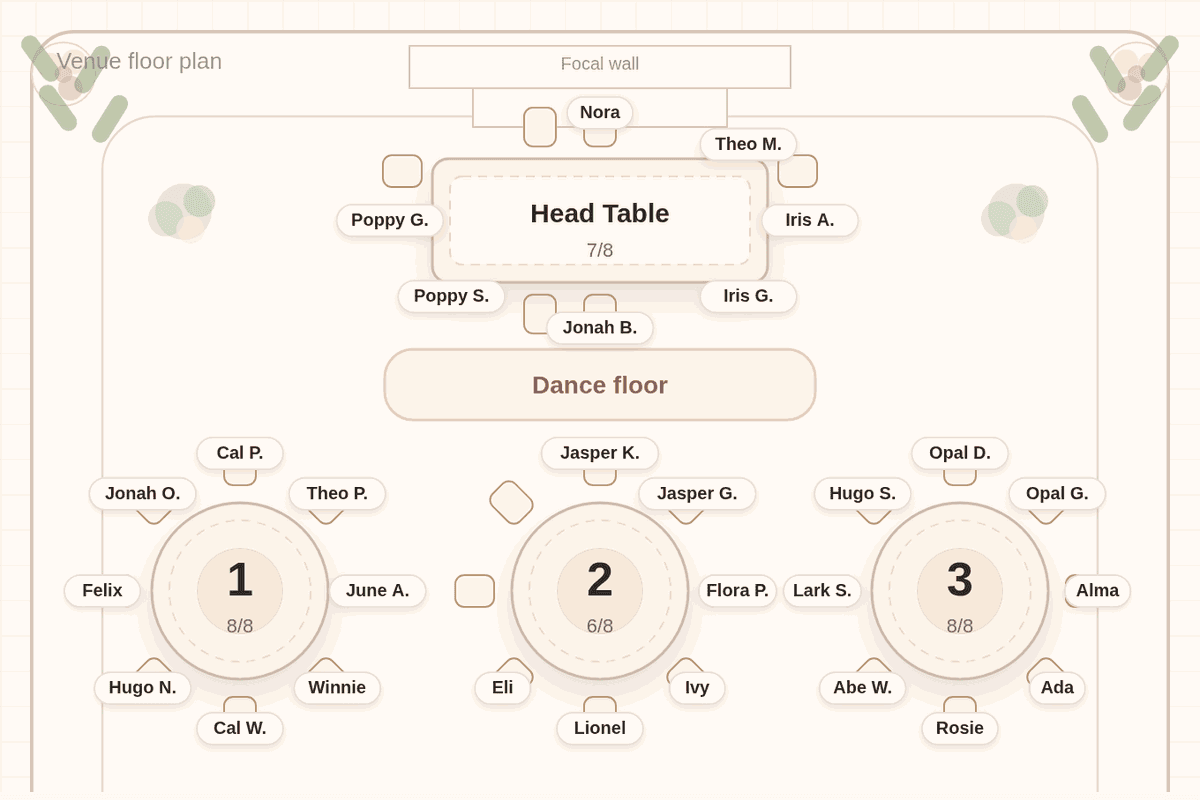
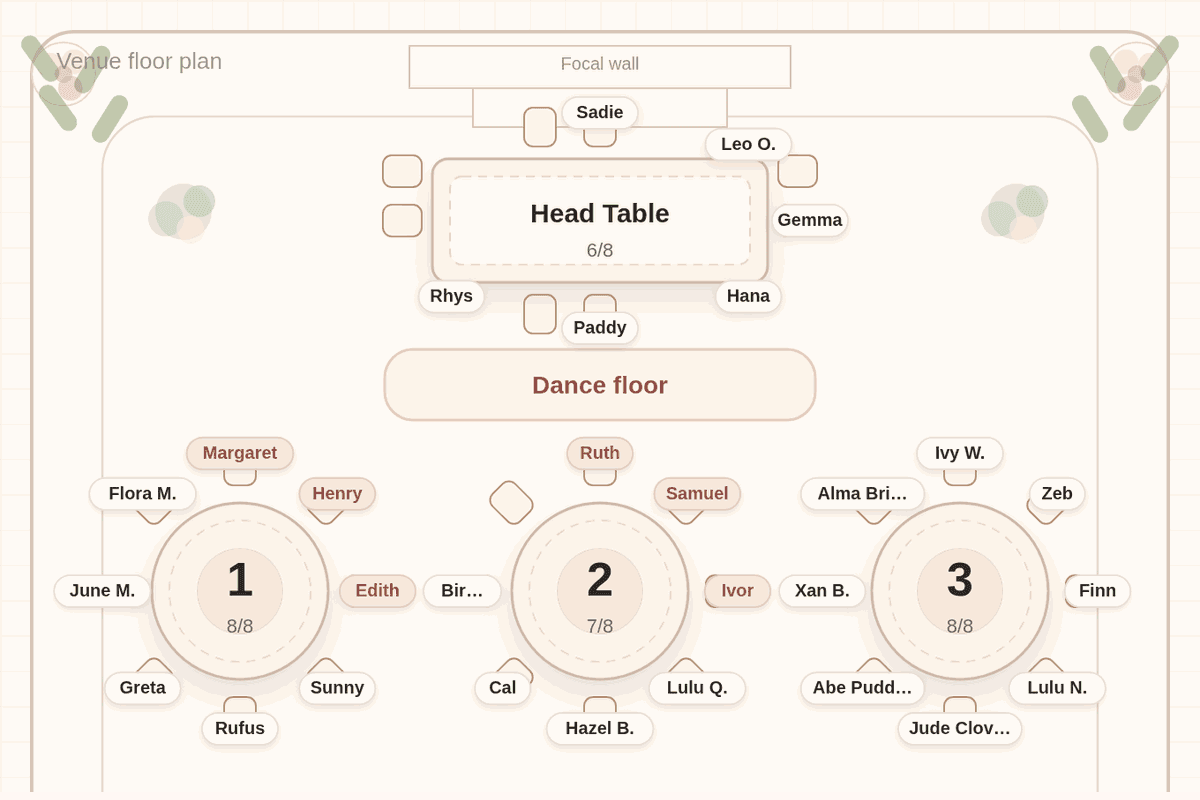
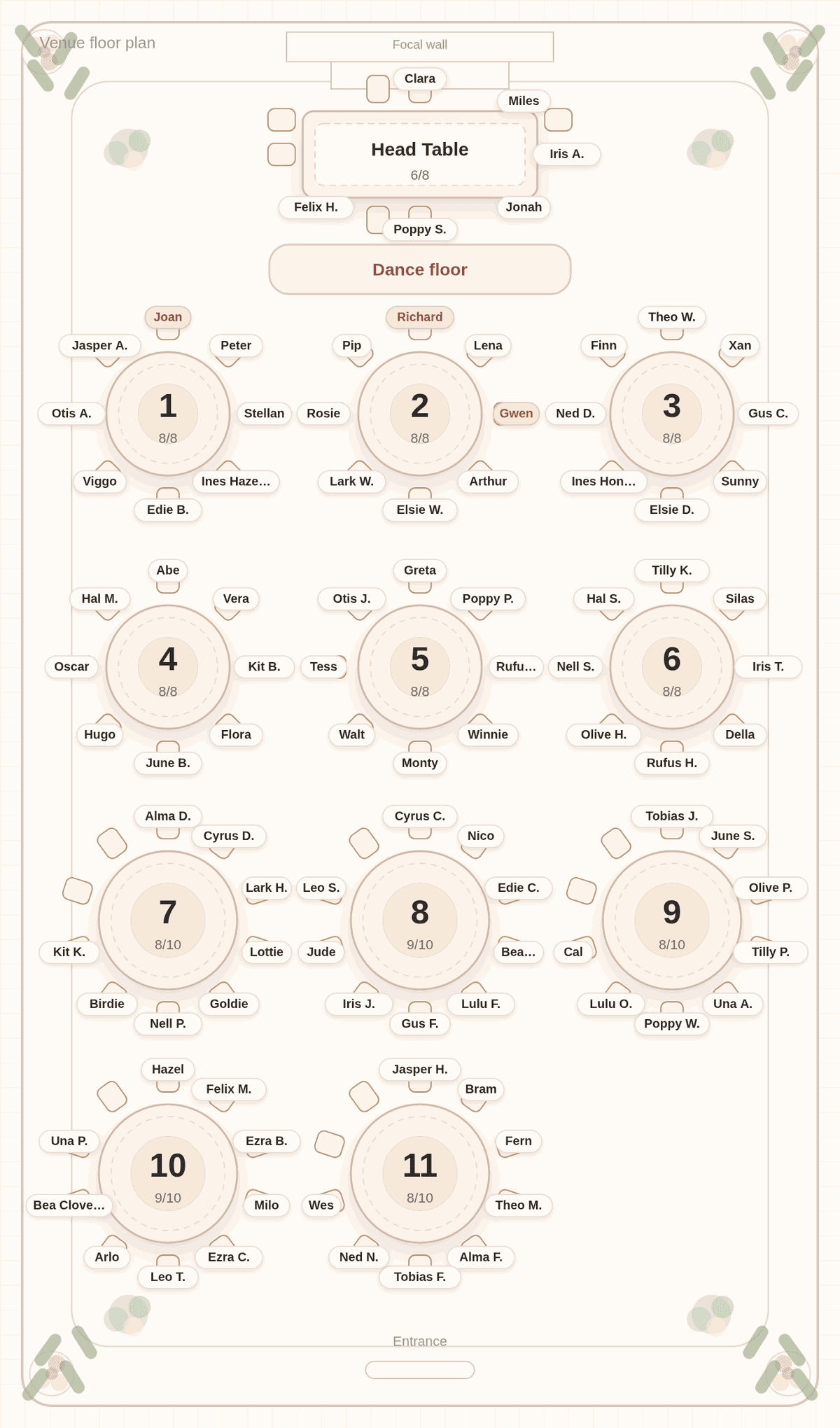
The chart below is one real way to handle the in-between case. We pasted a made-up list of 96 guests into Tablecharm. The bride's mother Joan came with her husband Peter, and her father Richard with his wife Lena. We added one rule to keep Joan and Richard at different tables and asked for both of them, and the groom's mother, to sit near the head table. Then we solved.
Start from how they get along now
Before you pick tables, answer one honest question for each pair of parents: can they share a table for three hours and enjoy it? Not "should they" and not "could they, for your sake". The answer sorts families into three cases:
- They get along. Seat them together with their partners if they like, often at one large family table.
- They are polite. Give each their own table, close to the front and close to each other.
- They should not be near each other. Give each their own table, and put real space between them.
If you are not sure, ask each parent privately. Most will be glad you did.
Stepparents sit with their partner
Whatever you decide about the parents, a stepparent sits with the parent they came with. Seating a stepmother away from her husband to spare someone else's feelings singles her out in front of the whole room, and it rarely spares anyone.
This is also the easy part in Tablecharm. If you paste each couple on one line, like "Richard Ashgrove and Lena Ashgrove", they are one household and always sit together. The keep-apart rule then only needs to name the two parents. Their partners follow them.
Give each household a table of honor
The traditional honor is a table near the head table, often with each parent hosting grandparents, siblings or close friends. With divorced parents, the fair version is two tables of equal standing: both in the front row, both with a clear view of the head table, neither tucked beside the kitchen.
In the chart above, Joan's table and Richard's table are both in the first row. The groom's parents, Gwen and Arthur, share Richard and Lena's table, so each front table has a host couple and neither reads as the lesser one.
Distance is about sightlines, not miles
Keeping two people apart does not require opposite corners of the room. Two tables side by side, with each parent facing the head table, is often enough. They can each see the toasts without sitting across from each other all dinner.
If the relationship is worse than that, move one table a row back or across the dance floor, and make up for it with a better seat for the toasts or a first dance with that parent. What you want to avoid is one parent obviously banished, which guests notice and remember.
Should stepparents sit at the head table?
Only if the parents sit there too. A head table with one parent and a stepparent, but not the other parent, makes a statement you probably do not intend. A common solution is a head table of just the wedding party, or a sweetheart table, and seat every parent at a table of honor nearby.
When the rules cannot all be true
Blended families can produce rules that contradict each other: two parents apart, both near the head table, a big sibling group together with one of them, and only so many front-row seats. Tablecharm treats "Absolutely must" rules as hard limits and near-the-head-table as a preference. If a hard rule cannot be kept, it tells you which one and why, instead of quietly breaking it. Usually the fix is one more table or one softer rule.
Questions couples ask
Do divorced parents sit at the same table at a wedding?
Only if they get along. Otherwise give each their own table of equal standing near the front. See divorced parents seating etiquette for more cases.
Where does a stepparent sit if they are new to the family?
With their partner, at that parent's table. A new partner is still a guest of honor's partner, and separating them draws more attention than seating them together.
What if my parents' partners do not get along with each other?
Treat it like the parents: separate tables, both near the front. In Tablecharm one keep-apart rule between the two parents covers their partners too when each couple is pasted on one line.
Seat your family without a fight
Paste your list below with each couple on one line. Add the keep-apart rule after the first solve, and the next solve moves as few people as it can.
No list handy? Try it with a sample list first. The editor and solver are free, with every table readable in preview. Payment is for final files and the guest link.

Useful next
- Divorced parents seating etiquette: more arrangements for parents
- Family drama seating chart: feuds beyond the parents
- Who sits at the head table: the three usual options