Seating problems
Seating an ex at a wedding
Different tables, not opposite walls. Each of them sits with their own people, and one firm rule keeps it that way through every change.
Updated
Sometimes two people on your list used to be together. Maybe it ended well, maybe it did not. Either way, you are not going to leave one of them off, and you would rather they spend dinner at different tables. The good news is that this is one of the easiest seating problems to solve, as long as you decide it once and write it down.
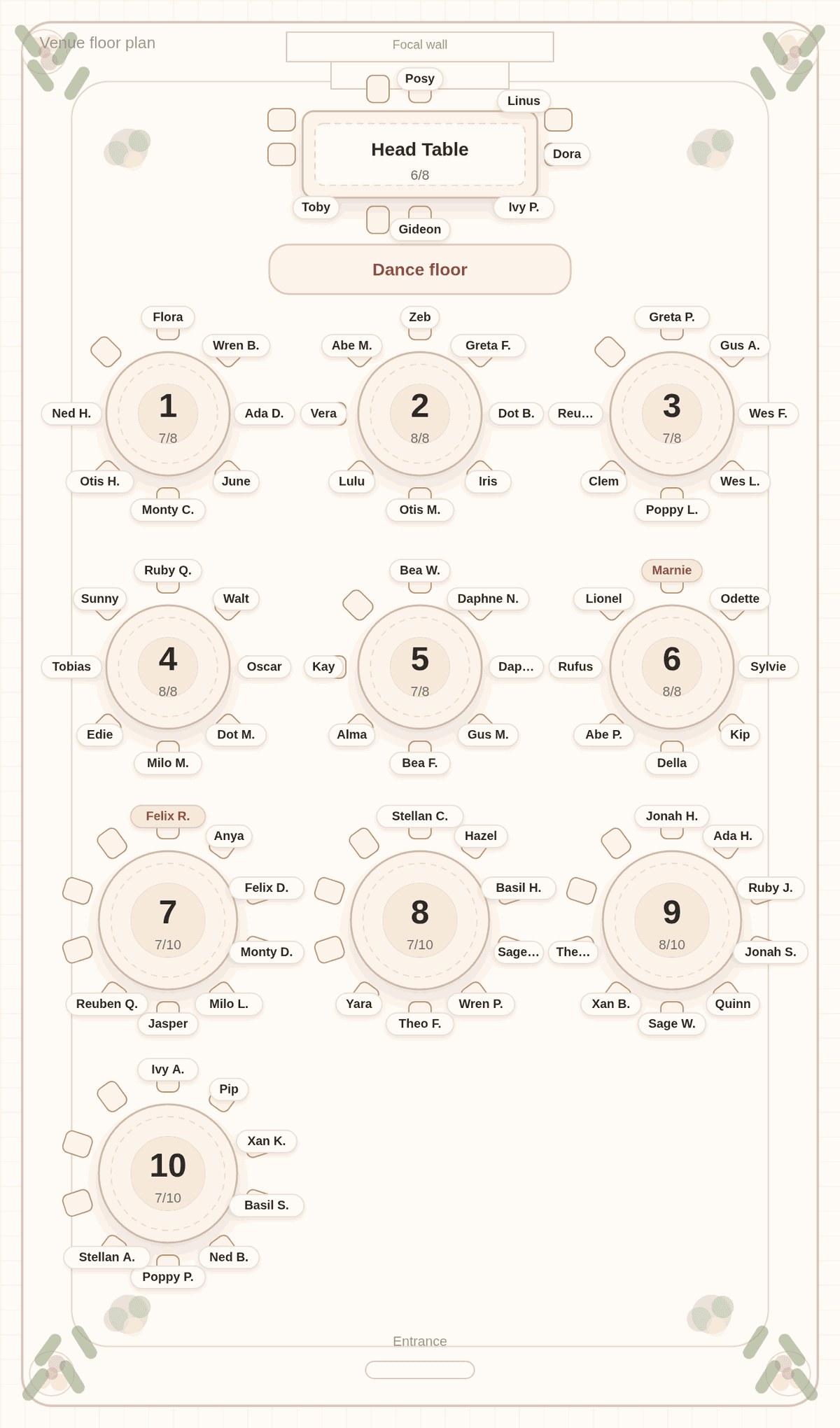
The chart below is a real solve. We pasted a made-up list of 80 guests into Tablecharm. Felix is coming with his wife Anya; his ex, Marnie, is coming with three college friends. We added one keep-apart rule between Felix and Marnie, set to "Absolutely must", tagged Marnie's friends "college" and solved. Felix and Anya sit at Table 7; Marnie and her friends sit at Table 6.
Decide how much distance they need
Start by being honest about the situation, not the worst case. Most exes need only one thing: not to be at the same table. They can share a room, a dance floor and a buffet line perfectly well. A few need more, like a table on the other side of the room or at least not facing each other.
If you are not sure, ask the person closer to you. "Is it fine if you are at a different table from Felix, or would you like more space than that?" is a kind question, and the answer settles it.
Give each of them their own people
The best protection is a good table. An ex who is sitting with close friends is having a nice evening, and is not scanning the room. So put each of them with the people they came with or know best.
In our chart, Felix sits with his wife, because they were pasted on one line and a household always sits together. Marnie sits with her three college friends, because they share a tag. Neither of them is stuck at a table of strangers with nothing to do but notice the other.
Write one firm rule
In Tablecharm you add a rule by tapping two guests and choosing Keep apart. Then you pick how firm it is: "Absolutely must" or "If possible". For an ex, choose "Absolutely must". The solver treats that as a hard limit and never seats the two together.
The rule covers only the two people you name, not their partners or friends, which is usually what you want. If a hard rule ever cannot hold, for example because every table with room is already the other person's table, Tablecharm says which rule and why instead of quietly breaking it.
Sightlines, if the ending was hard
Different tables are enough for most people. When they are not, think about what each person sees. Two tables in the same row can be fine; two tables facing each other across a small room may not be.
The solver assigns tables, not positions in the room, so this part is yours. Look at the floor plan after the solve. If Felix and Marnie ended up side by side, lock the tables you like and drag one of them to a table further away; the move becomes a pin that the next solve keeps. In our chart their tables are in different rows, one to the right and one to the left, and that was enough.
It holds through every change
Seating charts change right up to the last week. The value of writing the rule down is that it survives those changes. Every solve after the first in Tablecharm moves as few guests as it can and still honors every hard rule, so adding a late plus-one or removing a decline does not accidentally put the two exes together.
If you print a by-table poster, remember that both of them will read it. A calm, even layout helps. There is more on that in the alphabetical or by table guide.
Questions couples ask
Should you invite an ex to a wedding?
That is your call, and the couple's. If they are invited, the seating part is simple: different tables, each with their own friends, and one firm keep-apart rule.
How far apart should exes sit at a wedding?
For most people, different tables is enough. If the relationship ended badly, put the tables in different parts of the room and avoid seating them facing each other.
What if my ex's new partner is also coming?
Seat the new partner with your ex, as you would any couple. The keep-apart rule only needs to name the two people who used to be together.
Will Tablecharm ever break a keep-apart rule?
Not one set to "Absolutely must". If it cannot be kept, the app tells you which rule and why, so you can add a table or change something else.
Keep two guests apart, for good
Paste your list below and solve. Then tap the two guests, choose Keep apart and "Absolutely must", and solve again. Nobody else moves more than they have to.
No list handy? Try it with a sample list first. The editor and solver are free, with every table readable in preview. Payment is for final files and the guest link.

Useful next
- Family drama seating chart: more conflicts, same approach
- How the generator works: hard and soft rules
- Divorced parents seating: when the exes are the parents