How to
Mixing friend groups at wedding tables
Keep groups together by default, mix them on purpose, and never leave one friend stranded. Shown on a solved chart of 90 made-up guests.
Updated
Most guest lists are a handful of friend groups stitched together: college, work, a book club, the neighbors you grew up with. The question is whether to keep each group at its own table or to mix them so people meet. Both are fine. What goes wrong is the accidental version, where most of a friend group fills one table and one friend ends up alone across the room.
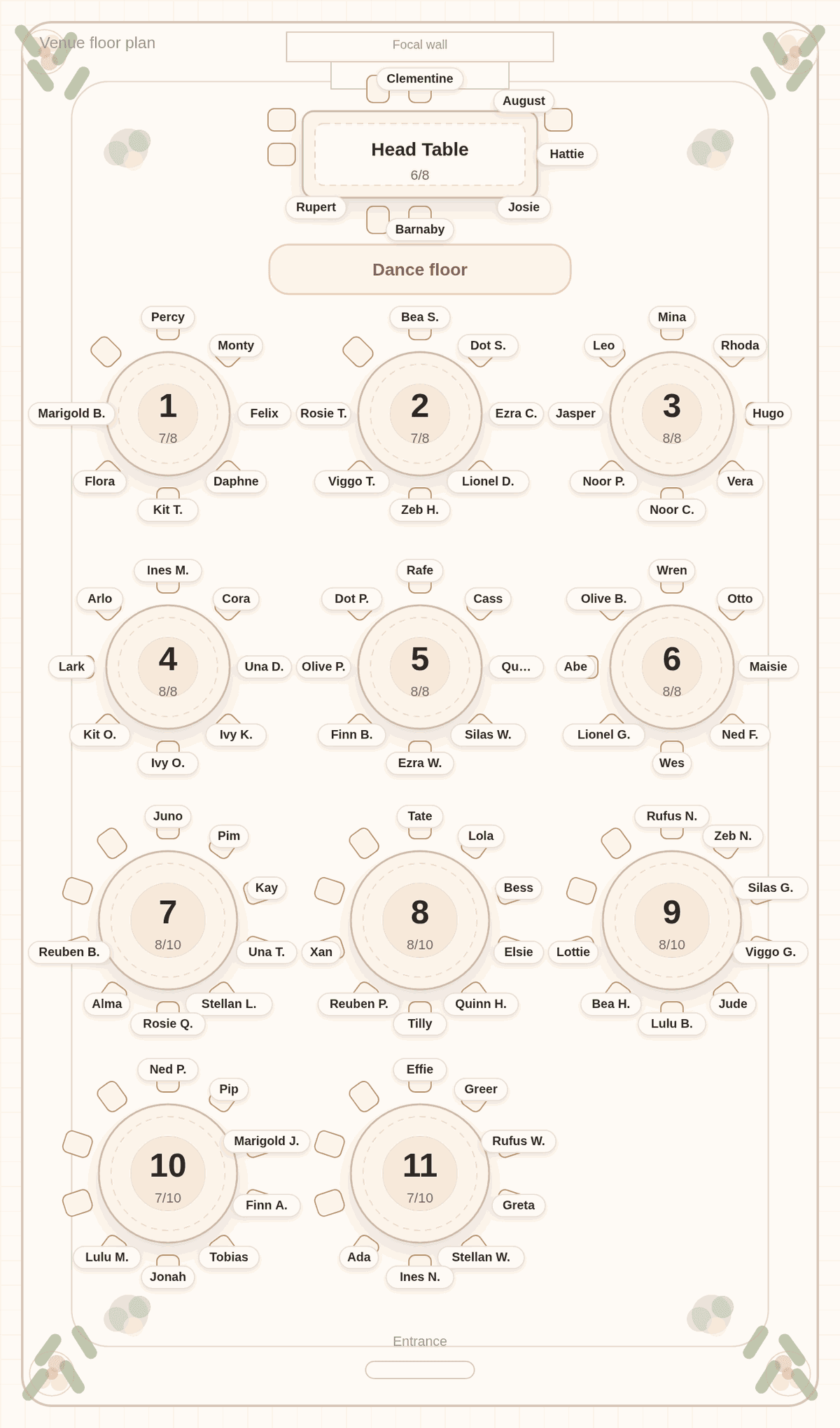
The chart below is a real solve. We pasted a made-up list of 90 guests into Tablecharm, tagged six friends "college", four "work" and five "book club" (Maisie is in both college and book club), and pressed Solve. Every tagged guest sits with at least one other person from their group.
Keep groups together by default
A wedding is a long evening. Most guests enjoy it more next to people they already know, and a table of old friends is usually the loudest and happiest table in the room. So start from groups, not from a plan to mix everyone.
The practical first step is naming the groups. Go through the list once and write a short label next to each friend: "college", "work", "book club", "soccer". In Tablecharm these are tags. A shared tag tells the solver these people know each other, and it leans toward seating them together.
Why big groups split, and why that is fine
Our college group has six people and our tables seat eight or ten. That sounds like it should fit at one table, and sometimes it will. But the same table also has to hold whole households, and every other table has to come out even.
Tablecharm treats a tag as a preference, not a rule, and it caps how strongly one tag can pull. That stops one group from crowding a table at the expense of everyone else. In the chart, the college friends split four and two: Wren, Otto, Maisie and Ned at Table 6, Rafe and Cass at Table 5. The four work friends split two and two, with Tate's partner Lola beside him. Nobody is alone.
If a group must stay whole, say so. A keep-together rule set to "Absolutely must" holds the group at one table, and Tablecharm tells you plainly if no table has room for all of them.
Mix on purpose, in small doses
Mixing works best when each table has a solid core and one or two newcomers. Two college friends plus a work couple who like to talk is a good table. Eight people who each know one other person is a quiet one.
Some ways to mix without risk:
- Pair two small groups with something in common, such as two sets of friends who both have young kids.
- Seat a friendly couple you trust with a guest who knows fewer people.
- Give people who overlap two groups, like Maisie in our chart, the job of bridging them.
The guide on guests who don't know anyone covers the harder case of people with no group at all.
The one thing to avoid: the lone friend
The failure that guests remember is not "we were mixed". It is "all my friends were at Table 4 and I was at Table 9". Check for it after every solve.
Tablecharm helps here. After a solve it lists anyone who knows nobody at their table, judged from shared households, shared tags and neighboring lines in your list. Its first solve already prefers to seat people with someone they know. If the check still names people, "Fix it" runs one more solve that tries harder, moving as few other guests as it can.
Groups and the rest of the room
Friend groups are not the only thing a table has to balance. Households always stay together. Children tagged "kids" lean toward the same table. If you mark each guest's side (A, B or Both), the solver prefers not to mix the two families at a table unless you ask it to. None of these beat a hard rule, and none of them move the head table, which only seats the people you put or tagged there.
If you want a table that mixes on purpose, for example your college friends with your partner's, tag them all "college" and mark them Both.
Questions couples ask
Should friend groups sit together at a wedding?
Usually, yes. Guests enjoy the night more beside people they know. Mix small groups on purpose where you think they will get along, and make sure no one ends up the only member of their group at a table.
How do I keep a friend group together in Tablecharm?
Give them a shared tag, like "college", and the solver leans toward seating them together. For a group that must not split, add a keep-together rule and choose "Absolutely must".
What if a friend group is bigger than a table?
Split it into two tables side by side, with at least two or three friends at each. A tag already tends to do this; a keep-together rule cannot, because no single table can hold the whole group.
Is it rude to mix guests who don't know each other?
No. Mixing is normal. What matters is that every guest has at least one person at the table they can talk to from the start.
Tag your groups and solve
Paste your list below. Add a tag for each friend group in the editor, then solve and check that nobody sits alone.
No list handy? Try it with a sample list first. The editor and solver are free, with every table readable in preview. Payment is for final files and the guest link.

Useful next
- How the generator works: tags, rules and what happens when they conflict
- Family drama seating chart: when the groups do not get along
- Kids table seating: the other group with its own plan