Online seating chart maker that assigns the seats, not just the sign
Search for a seating chart maker and almost everything you find is a design tool. It gives you a pretty board and a font. It still expects you to know that Aunt Rosa cannot sit near her ex-husband, that the college friends want one table, and that table nine has two seats left with nobody sensible to fill them. That part, the hard part, is left to you.

What making a seating chart actually involves
The layout is the visible part and the smallest part. The real work is constraint solving, even if nobody calls it that:
- Groups that belong together. Families, university friends, colleagues. Split one across two tables and somebody notices.
- People who must be kept apart. Divorced parents, a fired business partner, an ex. This is the constraint people are most anxious about and least willing to write down in a spreadsheet.
- Tables that have to come out even. Ten seats, a group of seven and a couple. The arithmetic only works from certain starting points.
- The list changing. Three declines a fortnight out can undo an arrangement you spent an evening on.
A design tool cannot help with any of that, because it does not know who anybody is. It is why so many couples end up doing the arranging on paper first, then rebuilding it in a maker afterwards.
How Tablecharm is different
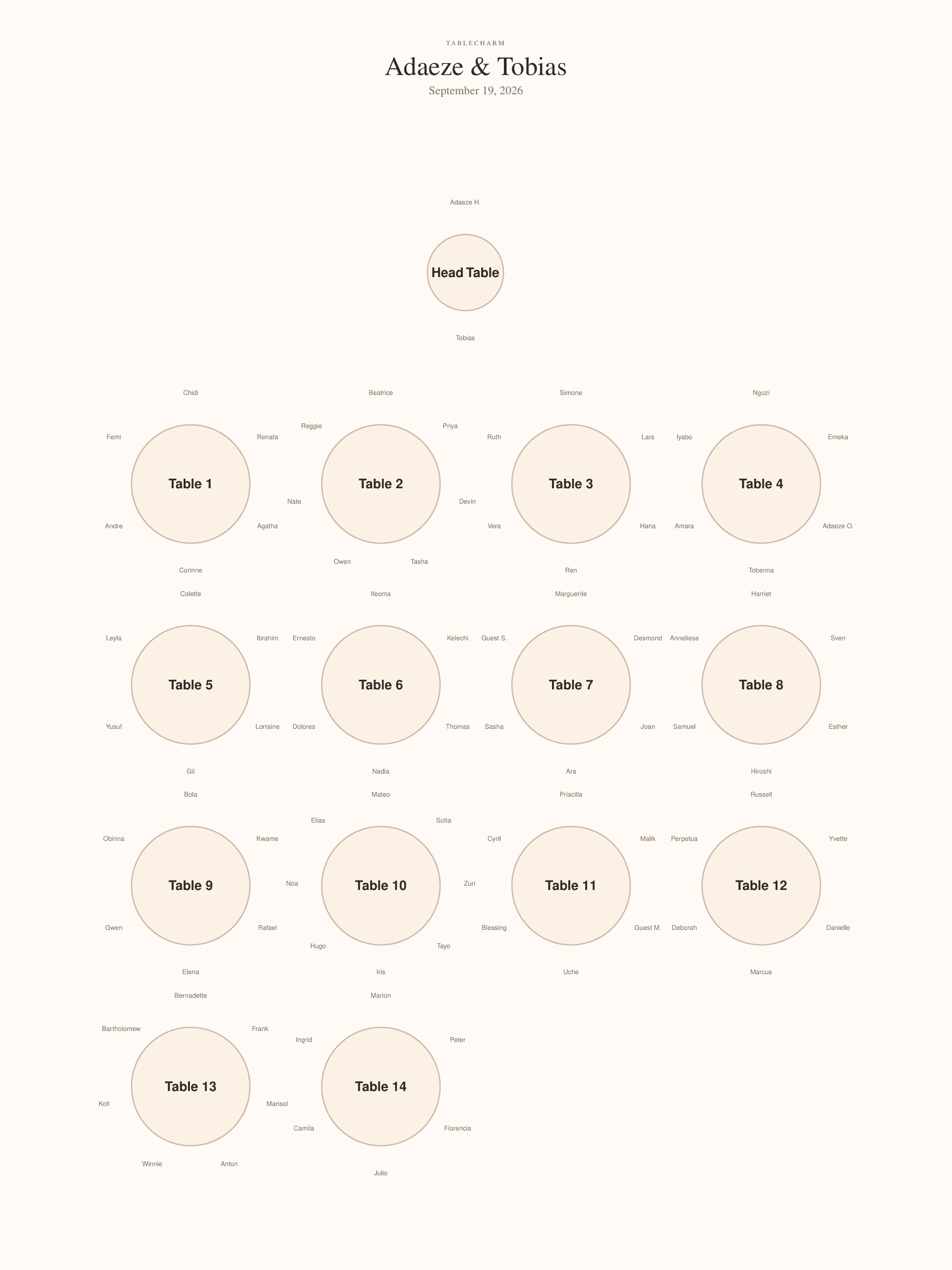
You paste your guest list, say how many tables you have and how many seats each, and pick who sits together and who stays apart. Tablecharm assigns every guest, respects the rules it can, and tells you plainly when two rules cannot both be satisfied instead of quietly picking one. Then it prints: a poster, place cards, and an escort list.
It is free to try: paste your list and see a solved chart before paying anything. Unlocking one wedding is $29, once, with a 7-day refund. If you would rather not touch it at all, we will do the whole thing for you for $45.
Questions couples ask
What does a seating chart maker do?
A real maker assigns every guest to a seat from your list, table sizes, and together/apart rules. A design board only draws the chart after you already decided who sits where.
Is Tablecharm’s seating chart maker free?
You can paste your list and see a solved chart before paying. Unlocking one wedding is $29 (prints and escort included). Or have us do it for $45.
Can it keep people apart (divorced parents, exes)?
Yes. Pick two guests and choose Keep apart; Tablecharm seats around them and tells you when two rules cannot both be true.
Maker vs generator?
Same solver. This page is for “maker / creator / builder / online” searchers. The generator page is for people searching “generator” and paste-list workflows.
Web or App Store?
Desktop: try free at /app. Mobile: get Tablecharm on the App Store (id 6790002345) for the same unlock.
Keep reading
- Seating chart generator: how constraints are handled, and what happens when they conflict.
- Seating chart guides: head table, escort cards, kids table, and the rest of the set.
- Venue floor plans: start from the room you already have.