By guest count
Seating chart for 120 guests
Fourteen rounds around a dance floor in the middle of the room. The table math, the layout, and what the solver did with it.
Updated
At 120 guests a reception is a real room: fourteen or fifteen tables, a dance floor, a bar, and a lot of people who want a good view of the couple. It is also the size where the room layout starts to shape the evening. A dance floor in the middle of the tables keeps the party at the center; one at the front turns the room toward a stage.
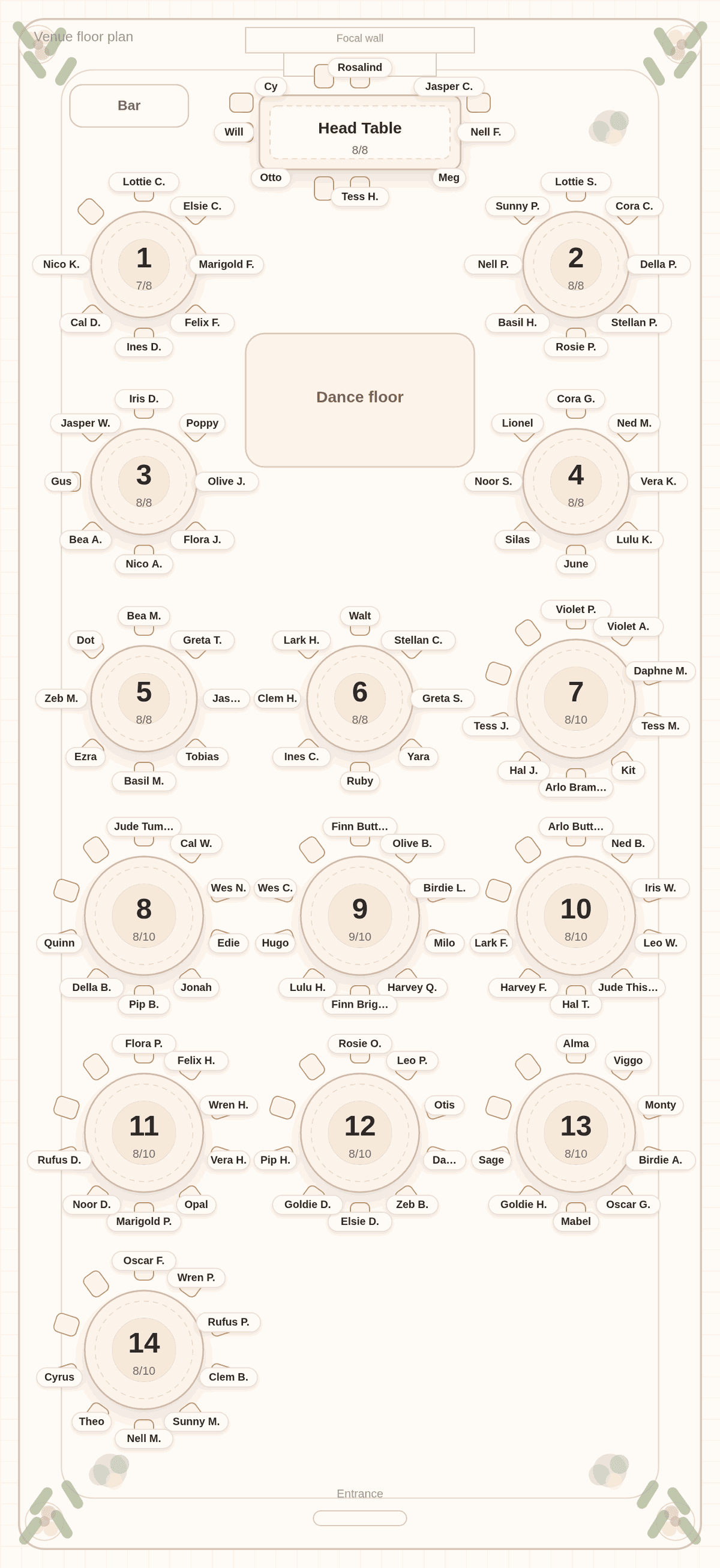
The chart below is a real 120-guest solve around a center dance floor. We pasted a made-up list into Tablecharm, tagged the couple and six attendants for the head table, accepted the room plan the app offered (eight rounds of ten added to six rounds of eight), chose the Center dance floor layout, and solved.
The table math for 120
Take the head table out first. With the couple and six attendants there, 112 guests need seats. At rounds of ten that is twelve tables at the least; at rounds of eight it is fourteen.
Our room started with six rounds of eight, 48 seats. The app said so, and offered eight rounds of ten on top, for 128 seats. With 112 guests at those tables there are 16 spare chairs, and the solver spread them: most tables of ten hold eight, one holds nine, and one table of eight holds seven. The how many tables guide has the method in full.
What a center dance floor changes
With the dance floor in the middle, the tables closest to it get both the best view and the most noise. Everyone else is only a few steps from the floor, which keeps the room together once the music starts.
In the Center dance floor layout the editor places tables on both sides of the floor and fills the room behind it, with a bar in the top left corner and the head table at the front. The solver does not know where the dance floor is. It fills the tables you have, and it treats the head table as reserved for the people you tagged or placed there.
Choose the front tables on purpose
At this size the tables that matter most are the four around the dance floor and the head table. Decide who sits there before you solve: parents, grandparents, and the friends who will dance first.
There are two ways to put people there. A near-the-head-table rule marks a guest for the tables closest to the couple, and the solver prefers those. Or drag a guest to a specific table, which pins them there for every later solve. Use rules for the few who matter, and let the rest of the room fill itself.
Households, groups and the other hundred
Most of the 120 do not need individual rules. Paste each household on one line so it is never split, tag friend groups so people land with someone they know, and mark each guest's side if you would like the families mostly at their own tables. After the solve, Tablecharm lists anyone who knows nobody at their table, and "Fix it" runs one more solve to help them.
When the list changes, solve again. Every solve after the first moves as few guests as it can and tells you what moved.
Printing for 120
A by-table poster for fourteen tables is readable, but guests will take a moment to find their names. An alphabetical Find Your Seat poster is faster at the door, and Tablecharm prints both from the same chart. The floor plan export draws this room with a number on every table. Names stay on the posters, and the venue can match those numbers to its own plan. More in alphabetical or by table.
Questions couples ask
How many tables do I need for 120 guests?
If everyone sits at rounds, twelve rounds of ten or fifteen rounds of eight. With eight people at the head table, the other 112 need twelve rounds of ten or fourteen of eight. Add a little slack for late replies.
Is a center dance floor better than a front dance floor?
For a party-focused reception, often yes: everyone is close to the floor. A front dance floor suits a room built around toasts and a stage. Both work at 120.
Who should sit at the tables next to the dance floor?
The people you most want close: parents, grandparents if the music is not too loud, and the friends who will dance first.
Can Tablecharm put lively guests near the dance floor?
Not automatically. The solver does not rank tables by distance to the floor. Drag the guests to a table there, or mark them near the head table.
Solve your 120
Paste your list below. The app suggests tables for your count; switch to the center dance floor layout in the editor and solve again.
No list handy? Try it with a sample list first. The editor and solver are free, with every table readable in preview. Payment is for final files and the guest link.

Useful next
- Center dance floor layout: the room shape in this chart
- Seating chart for 100 guests: one size down
- Printable wedding seating chart: what to print at this size