Seating problems
Where to seat plus-ones at a wedding
The rule is simple: a plus-one sits with the person who brought them. The details are about wedding party dates and the names on the place cards.
Updated
Plus-ones feel complicated because you may not know them, may not know their name yet, and may be seating them next to people they have never met. But the core rule is simple and almost universal: a plus-one sits with the guest who brought them. Everything else is detail.
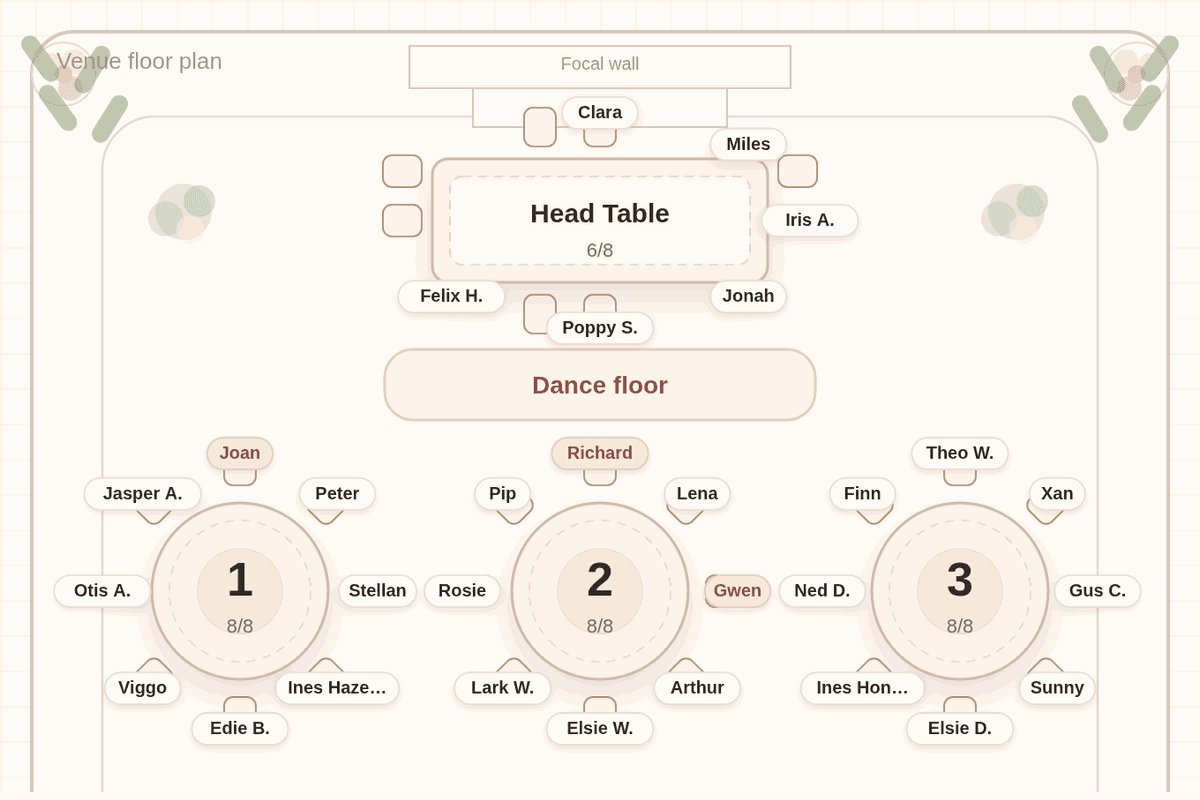
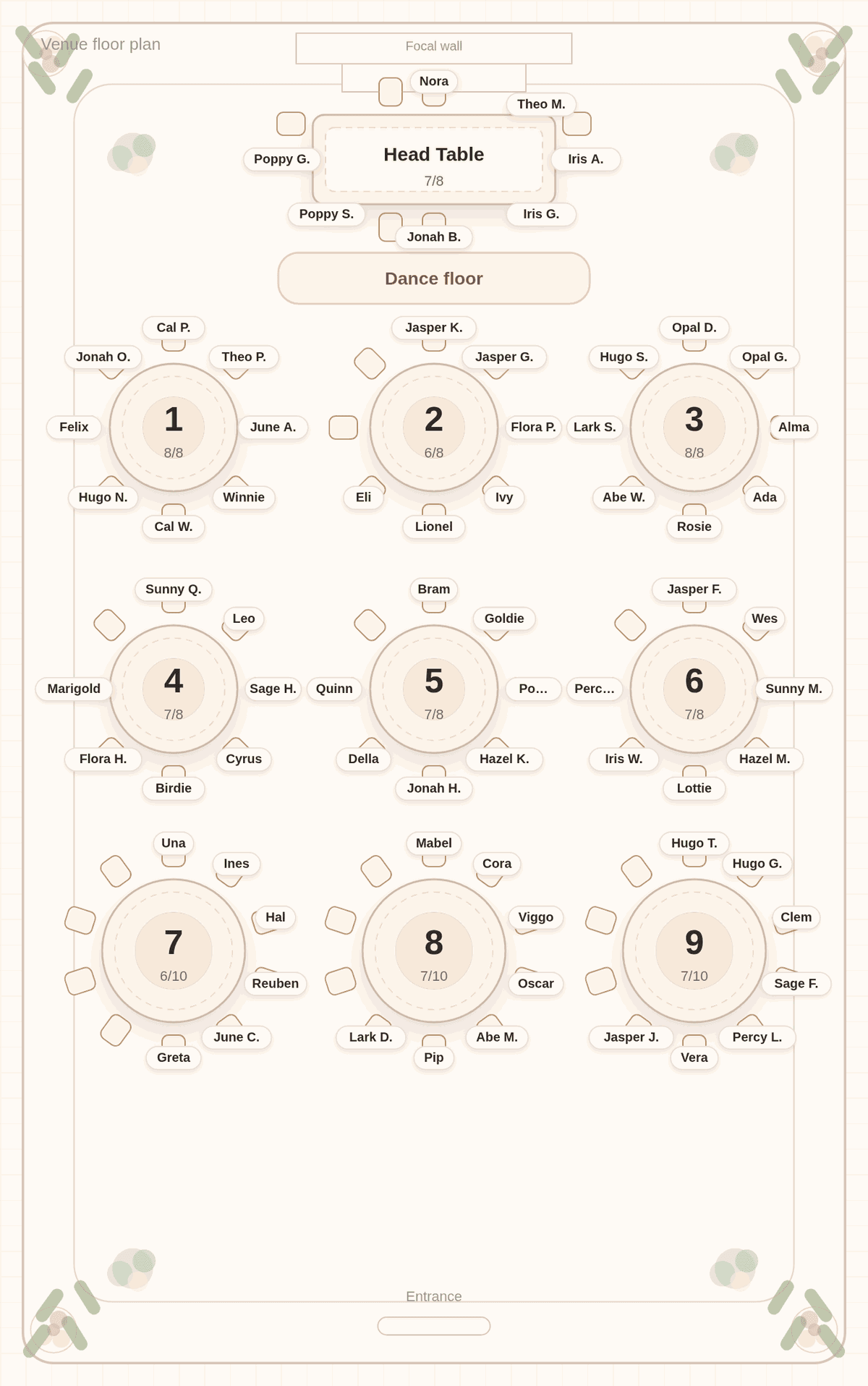
The chart below is a real solve. We pasted a made-up list of 70 guests into Tablecharm, with five plus-ones entered three different ways: "Jasper Kettleby +1", "Iris Applewhite and Guest" and "Opal Dewberry & Guest". Iris and Poppy are bridesmaids who each bring a date, so we tagged them "wedding party" and solved. All five plus-ones landed at the same table as the guest who brought them, including the two at the head table.
The one rule: together
A plus-one is there to keep someone company. Seating them at a different table defeats the purpose and leaves both of them sitting with strangers. So whatever else you decide, keep each guest and their plus-one at the same table.
In Tablecharm this happens automatically when you enter them together. "Jasper Kettleby +1", "Iris Applewhite and Guest" and "Opal Dewberry & Guest" all create two guests in one household, and a household always sits together. In the chart, Jasper and his guest share Table 2, and Opal and hers share Table 3.
Wedding party dates
The trickiest plus-ones belong to your wedding party. A traditional head table seats only the attendants, which can leave their dates alone at a table of strangers for the whole dinner. There are three good answers:
- Seat the dates at the head table too, if it is long enough.
- Seat the dates together at a table right in front of the head table, ideally with friends.
- Skip the long head table and use a sweetheart table, so attendants sit with their dates.
Our chart takes the first option. Because each date is in the same household as a tagged bridesmaid, Tablecharm lets them join her at the reserved head table, which is otherwise kept for the couple and the wedding party.
Plus-ones who know nobody
A plus-one usually knows exactly one person at the wedding. Seat that pair with the host's closest friends rather than at a leftover table, so the plus-one meets people through someone they trust. If two guests are each bringing someone new, seating the two pairs together gives the newcomers something in common. The guide on guests who don't know anyone has more on this.
Name them before printing
Here is the detail that causes real problems on the day. When you paste "Iris Applewhite and Guest", the second guest is named "Iris Applewhite's Guest" until you rename them. The chart labels them "Iris G.", which is why the head table above shows both "Iris A." and "Iris G.". On a place card or an escort list, a placeholder reads as an afterthought.
So before printing, ask each guest for their plus-one's name, and type it over the placeholder in the guest list. Tablecharm's "Ready to print or share" checklist counts any guest still carrying a placeholder name, so none slips through. If a name never arrives, decide on purpose: a card that says "Guest of Iris Applewhite" is gracious, and a card with a blank line is not.
Plus-ones you did not plan for
Sometimes a guest replies with a plus-one you did not offer, or a date is added late. Handle the etiquette question first; the seating is the easy part. Add the new guest on the same line as their host, and solve again. Tablecharm's re-solve moves as few people as it can to make room, and tells you who moved.
Questions couples ask
Do plus-ones have to sit with their date?
Yes, in almost every case. Separating a guest from the person they brought leaves both of them with strangers, which is the opposite of what the invitation promised.
Where do bridesmaids' dates sit?
Either at the head table with them, at a table right in front of it, or, with a sweetheart table, with their partner at a regular table. Decide early so the dates are not an afterthought.
What if we do not know the plus-one's name?
Ask the guest before printing. If you still do not have it, print "Guest of" and the host's name rather than a placeholder like "Guest 1".
Does a plus-one get their own place card?
Yes. Every person at a table gets their own card, with their own name. That is one more reason to collect plus-one names before the stationery goes to print.
Paste your list, plus-ones and all
Write "+1" or "and Guest" after anyone bringing someone. The app keeps every pair together and lets you rename them before printing.
No list handy? Try it with a sample list first. The editor and solver are free, with every table readable in preview. Payment is for final files and the guest link.

Useful next
- Head table vs sweetheart table: the choice that decides where dates sit
- Wedding place cards: names that print well
- Escort list template: check every name before it prints